After the first day, we spent time traveling from Bangkok to Siem Reap and exploring the city’s ambiance. Today marked the highlight of our trip as we set out to visit a place renowned as “one of the wonders of the world” — the “Angkor Wat- Angkor Thom” complex. For today’s journey, we engaged the services of a local guide we had arranged to meet while still in Thailand. This guide’s name was Sok Paul, whom we contacted through a Facebook as recommendation on the pantip.com website. It was highly praised for its reasonable price, excellent service, reliability, and honesty. Intrigued by the positive reviews, we unanimously agreed to hire Sok Paul as our guide for a negotiated price of 30 USD (averaging 7.5 USD per person) for the four of us. The mode of transportation he provided us with was a tuk-tuk, which, here, refers to a motorbike pulling a trailer with seating capacity for up to four people.

Our Guide with his Tuk-Tuk, Mr.Sok Paul
.
We kicked off today by waking up at four in the morning as we had planned, eager to freshen up. Our guide was scheduled to pick us up around five to take us to witness the sunrise at the Angkor Wat temple. We understood that after watching the sunrise, the guide would then bring us back to the hotel for some rest before we embarked on our exploration of Siem Reap again. Consequently, some of us skipped showering in the morning, mistakenly assuming that we could do it after sunrise. :-P However, in reality, once we finished admiring the sunrise at Angkor Wat, the guide informed us that we would have breakfast nearby and continue sightseeing right away. He explained that returning to the hotel would consume precious time and we wouldn’t be able to see everything. So, it turned out that some of us didn’t get a chance to shower in the morning. T_T”
Once the guide picked us up from the hotel right on time at five o’clock, the four of us hopped onto a tuk-tuk and headed straight to the Angkor Wat temple to catch the sunrise. The morning air in Siem Reap was comfortably cool, around 24 to 26 degrees Celsius. Our guide stopped along the way to help us purchase the entrance tickets in advance. These tickets allowed us access to all the temples within the Angkor Wat-Angkor Thom complex. The ticket prices varied based on the number of days we wanted to explore. They were available for one day (20 USD), three days (40 USD), and seven days (60 USD). Since we only had limited time and one day was sufficient to cover all the important sites, we decided to buy the one-day ticket. We didn’t delve too deeply into the details but instead focused on capturing the significant landmarks and timing our shots like professional photographers.
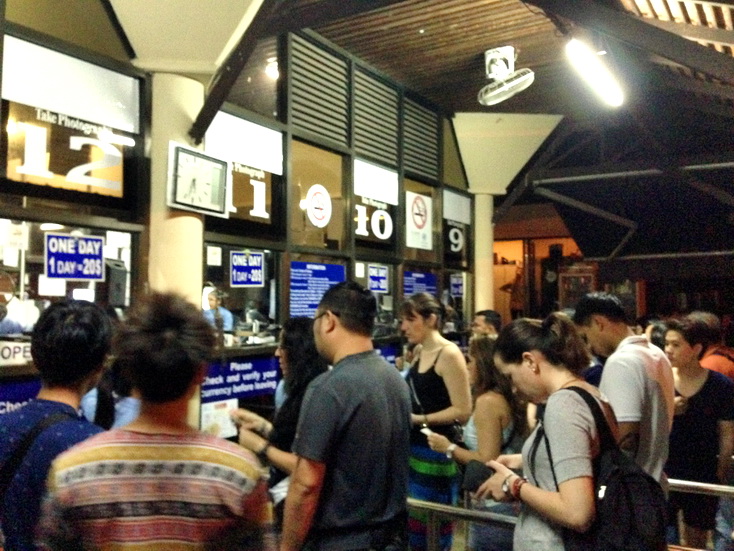
The ticket counters in front of Angkor Wat on 5.30AM. It had a lot of tourists and the queue was long. We spent almot 15 minutes to get the ticket.
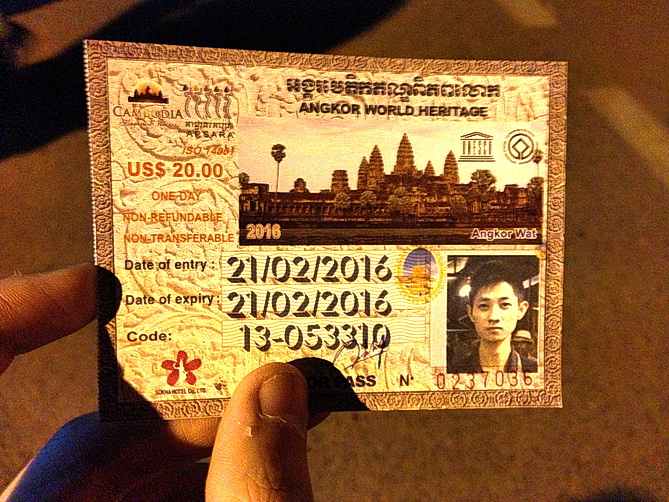
The ticket to entrance Angkor Wat – Angkor Thom. Every ticket had photo of purchaser (photo taking was done upon buying). At the entrance, the officer checked the photo in the ticket and allowed only same person as ticket to get in.
.
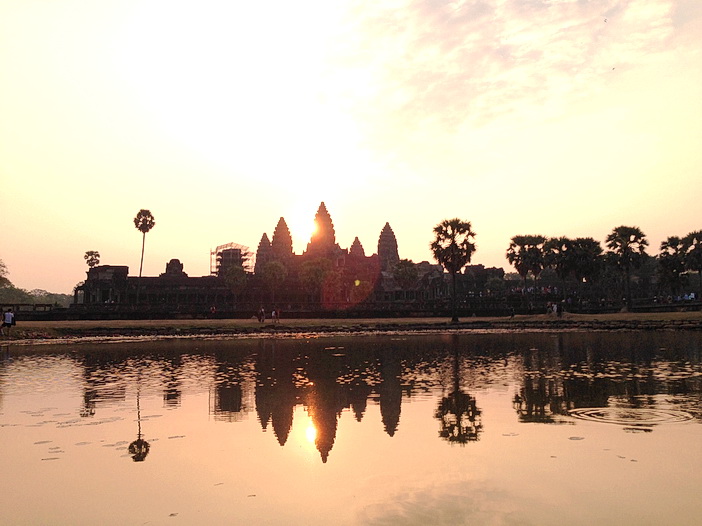
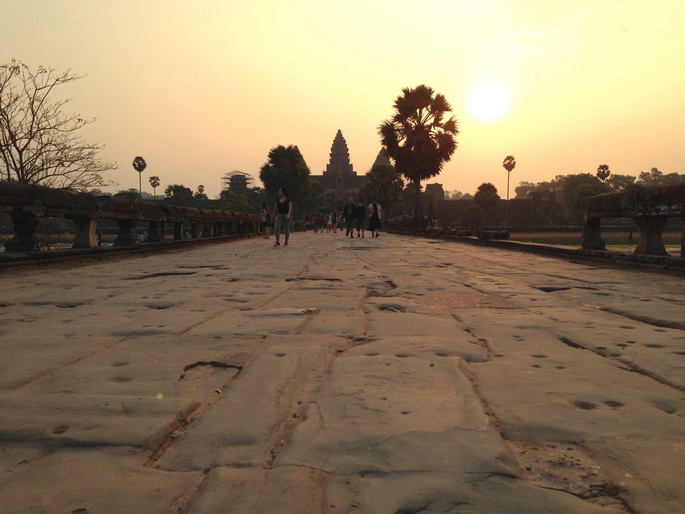
After obtaining our tickets, the guide immediately took us to the Angkor Wat temple because it was already half-past five, and the sunrise was approaching (let me tell you that witnessing the sunrise at Angkor Wat is something you shouldn’t miss, at least once in your life. But, of course, you have to hope for clear skies). When we arrived at the temple, we arranged with our guide to meet again around 7.30AM. He said he would wait for us at the entrance where he dropped us off. We hurriedly walked inside to secure a good spot to witness the sunrise. By the time we arrived, it was already crowded, with more than half of the visitors being Chinese tourists. As we made our way towards the entrance, we noticed a large pond-like water feature on both sides, separated by a central walkway leading to the temple. Turning our gaze towards the entrance, we saw that the left side of the pond was almost completely occupied, as this particular pool was famous for its perfect reflection of the temple. When capturing photos with the rising sun, it creates a marvelous spectacle. No wonder this side of the pond was so popular among professional photographers who had set up their cameras there even before we arrived. However, as iPhone photographers, we decided to follow suit and join them. That meant we chose to witness the sunrise from this side of the pond, despite the large crowd. But we were not intimidated.
We stood there waiting for the sun to rise for about 15 minutes. The sky began to blush, and the sunlight started to trickle in. However, on that day, there were a lot of clouds, making it difficult to catch a full, unobstructed view of the sun. As the sky brightened for about 10 minutes, several professional photographers started reluctantly packing up their cameras, disappointed. Some tourists also began to walk back, as the sky didn’t live up to their expectations. But weather conditions can change as quickly as people’s moods. Just when everyone had started to leave, not even five minutes later, the clouds began to shift, revealing the radiant sun in all its glory, perfectly framed against the backdrop of the temple’s silhouette. It was as if paradise had bestowed upon us this breathtaking sight. Without hesitation, we captured this beautiful moment, even though none of the four of us took turns being the photographer.
.
.

.
After capturing the sunrise at the temple, it was nearly 7AM when we strolled around the temple grounds, enjoying the atmosphere. Before meeting our guide and having breakfast at a restaurant nearby the temple, we decided to return to the temple in the afternoon to explore its interior.
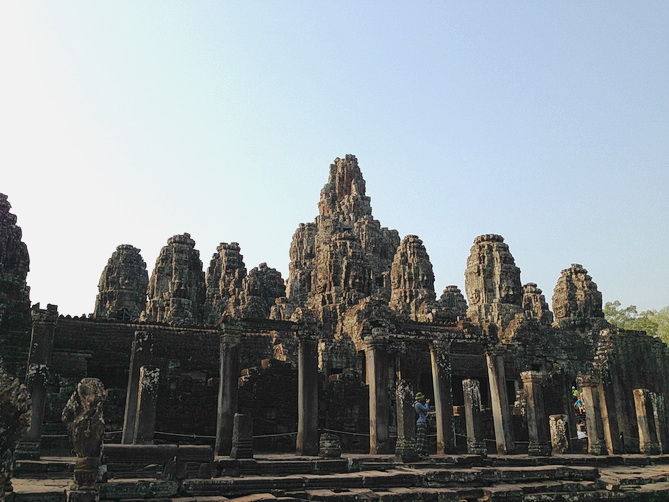
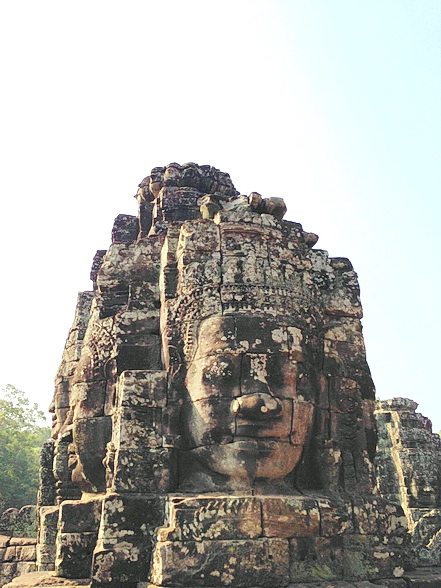
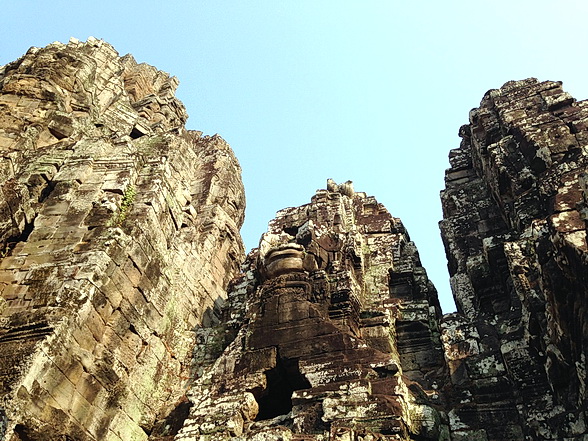
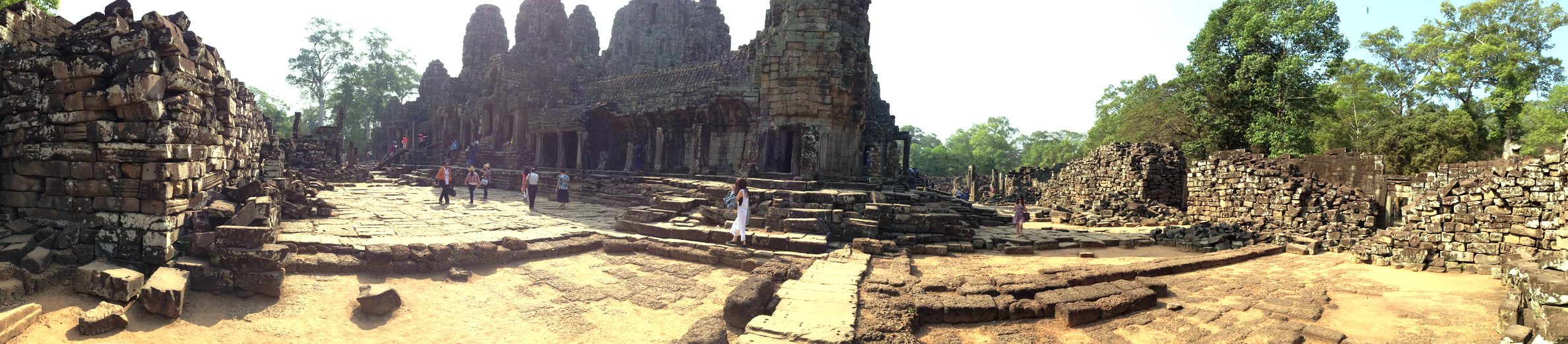
After having breakfast together, around half past eight, our guide led us to the next destination of the day, the “Bayon Temple.” It was located approximately 4 kilometers away from us. The Bayon Temple, situated within the “Angkor Thom” complex, was a stone temple of the Khmer Empire. It was built as the state temple of King Jayavarman VII during the years 1181 to 1220. Following King Jayavarman VII’s victorious campaign against the Champa Kingdom, the temple was designed with a unique feature of towers facing in all four cardinal directions, with a total of 49 towers. However, only 37 towers remain today. Generally, each tower had four faces representing the four directions, but some towers had three or two faces. The central part of the temple complex had multiple faces. We arrived at the Bayon Temple around 9AM. Our guide suggested spending about two hours here to fully appreciate all parts of the temple and allowed us to explore at our own pace. Then, they would meet us again around 11AM. (Note: There was no phone signal or internet connectivity in the Bayon Temple area, just so you know.)
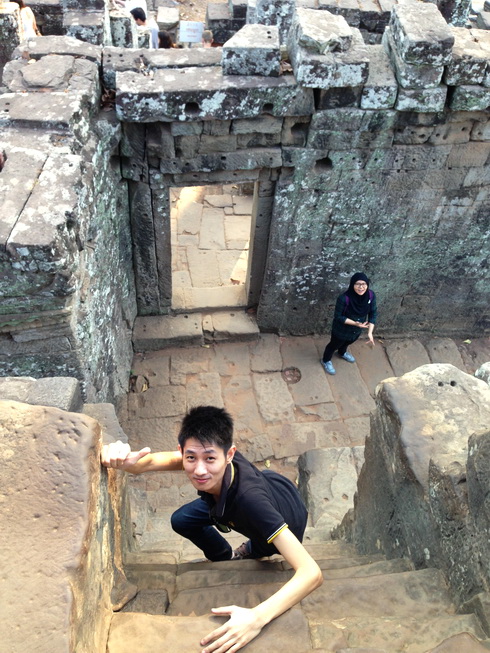
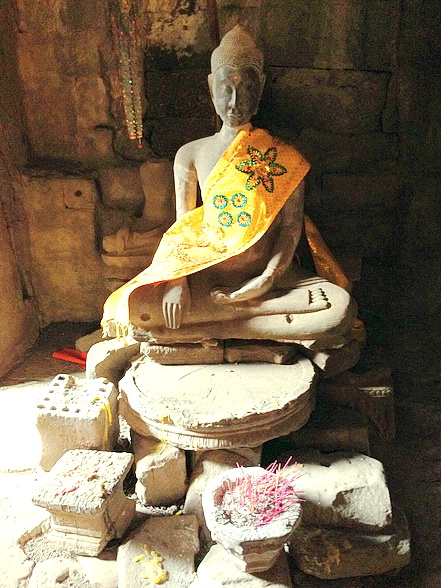
Once we had arranged the meeting time with our guide, we wasted no time. We eagerly walked towards the Bayon Temple to admire its beauty. I noticed that most of the visitors there were Chinese, and they seemed familiar with the routine of visiting the sunrise at Angkor Wat in the morning before continuing to the Bayon Temple. The beauty of the Bayon Temple lies in its numerous stone faces, hundreds of them, adorning the structure. There are also multiple levels and pathways inside the temple for exploration. What added to the excitement was the presence of tall towers, about 10 meters high, located at each cardinal point of the temple. These towers had staircases allowing visitors to climb up and enjoy the view from the top. However, the stairs were quite steep, with an inclination of about 70-80 degrees. Despite that, the four of us, being in our teenage years and filled with youthful enthusiasm, couldn’t resist the challenge of climbing up to prove our strength. (But it was a bit tricky coming down; it was steep and slippery!) This was the reason why we came up with the excuse that it’s better to travel while we still have the energy and excitement, rather than waiting until we’re older. And this staircase served as a great proof of our claim.
.

.
.

.
.

.
.
.

.
.
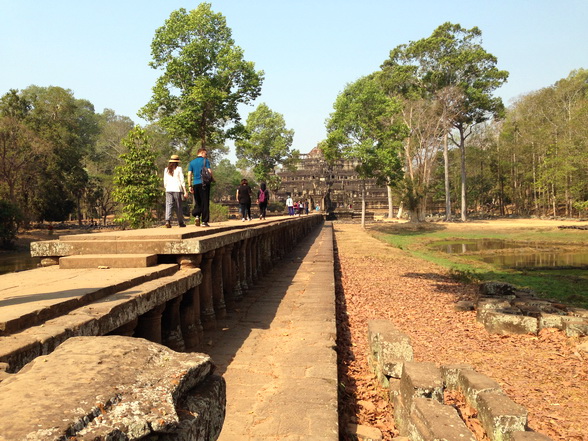
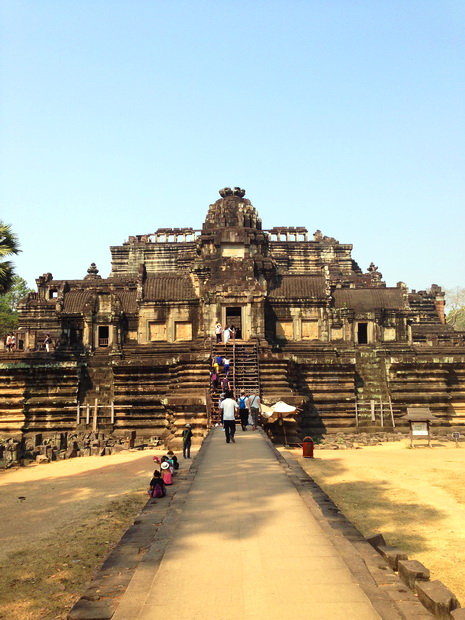
After we had finished exploring the main part of the temple, we still had about 45 minutes left. We decided to use that time to explore the surrounding area of the Bayon Temple, which was the location of a fortress-like structure resembling a city gate or a ceremonial site with a water reservoir. This fortress was located near the front of the Bayon Temple where we initially entered. It featured a long pathway that led to a tall, imposing entrance of the fortress. In the nearby vicinity, there was a water reservoir and an old city gate, which added a sense of grandeur to the place. It was fascinating to stroll around and take in the sights. As for the topmost part of the fortress, it provided an excellent vantage point to admire the beauty of the surroundings around the Bayon Temple.
.
.

.

.
After we had strolled around, exploring the fortress, water reservoir, and city walls near the Bayon Temple, it was time for our scheduled meeting with the guide at eleven o’clock. We met the guide as planned, and our next destination was the “Ta Prohm Temple.” This temple holds special significance for fans of action-adventure movies like “Tomb Raider” as it was featured prominently in the film. The temple gained worldwide fame for being one of the filming locations for this popular movie.

Images from the movie Tomb Raider, which used Ta Prohm Temple as a filming location.
.
Ta Prohm Temple was constructed in 1186 as a stone temple during the late period of the Khmer Empire. The Cambodian government had a unique concept for preserving the temple’s original state by keeping the trees intact, unlike other temples where trees were removed to prevent damage to the structures and potential dangers if they were to collapse onto the temples. This distinctive feature of Ta Prohm Temple is the abundance of large trees that envelop the temple in a captivating manner.
We arrived at Ta Prohm Temple around 11.15AM. Our guide suggested spending approximately an hour here to explore before meeting again at the temple’s opposite side for lunch at half-past noon. Without wasting any time, we eagerly proceeded to admire the temple immediately. Inside Ta Prohm Temple, clear directional signs guided visitors, ensuring that everyone walked in the same direction without any confusion or collisions. The walking path had two options based on the distance: “Short Walk” and “Long Walk.” Being adventurous and physically fit, we naturally opted for the “Long Walk” because we wanted to make the most of our visit. :-)
Inside Ta Prohm Temple, it felt as though we were journeying into an ancient stone temple filled with mystery and intrigue. The walls and doorways were adorned with overgrown trees and vines, giving a sense of hidden treasures like the fabled jewels. It’s no wonder that Ta Prohm Temple was chosen as a filming location for Tomb Raider, as the atmosphere truly captured the essence. However, exploring the temple required caution due to scattered rocks, collapsed structures, and various tree roots growing within its premises. These obstacles were scattered throughout, as the Cambodian government aimed to preserve the temple’s “majestic” appearance. Thus, the landscape remained untouched, with trees and even slightly elevated doorways that required careful navigation. One had to be mindful of head collisions, as someone around 160 cm tall would likely hit their head. It seemed that people of the past, during the temple’s construction, were not particularly tall, which explains the doorways’ height. Another precautionary measure was the abundance of collapsed structures. In some areas, adventurous visitors could climb on the ruins for photos without any barriers or signs. However, it’s important to respect the site and be mindful of what should not be done. We witnessed some tourists (nationality undisclosed) climbing on various collapsed structures to capture pictures, which seemed inappropriate in certain areas.

.

.

.

.

.

.
After circling around Ta Prohm Temple, it was finally time for our scheduled lunch 12.30PM, as we had arranged with our guide. By this time, we were all familiar with the routine, which was none other than the rumbling of our stomachs. We hurriedly approached the guide and asked him to take us to a nearby restaurant for a quick lunch. He promptly led us to a place he knew well. The restaurant, to be frank, was on the pricier side, with an average meal costing around 6 USD or more, excluding service charge. It was a set menu consisting of one serving of rice and a dish. It seemed like our guide had a connection with the restaurant, as if they had an agreement to bring customers there and receive a commission in return. Nevertheless, the food was delicious, with flavors not too different from Thai cuisine. The portions were generous, leaving us truly satisfied and compensating for the slightly higher price.

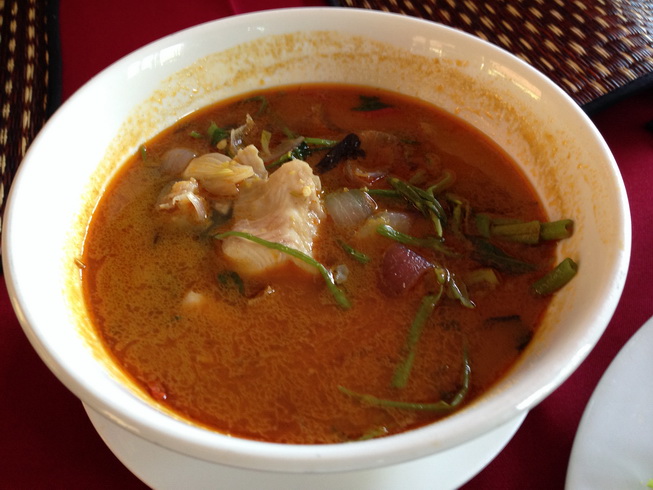

Our Lunch : Chicken red curry / Sour & spicy soup woth fish / Stir fried green mustard
.
Once our bellies were full, it was around half-past one, the perfect time for our guide to take us to the most anticipated and highly regarded highlight of our trip, Angkor Wat. We arrived at Angkor Wat around two o’clock, and our guide led us through the back entrance, which had fewer people compared to the main front entrance. This allowed us to explore Angkor Wat comfortably, with fewer crowds. The guide advised us to spend approximately three hours at Angkor Wat to ensure we covered every corner. We made another arrangement to meet at 5PM, in front of the temple (the area where we witnessed the sunrise earlier that morning), so he could escort us back to our hotel. With the timing set, we eagerly embarked on our journey to witness the renowned marvel that is considered one of the world’s greatest in no time.
Angkor Wat was constructed during the reign of King Suryavarman II in the 17th century, serving as a place of worship for the Vishnu or Narayana deity and becoming the designated religious center of the capital city. This magnificent temple complex has been remarkably preserved, standing as the sole surviving significant religious site of its kind to this day. Originally built as a Hindu temple, Angkor Wat later transformed into a Buddhist place of worship. It is the largest religious structure in the world, representing the pinnacle of Khmer classical architecture and becoming an iconic symbol of Cambodia. It is prominently featured on the national flag and serves as the country’s primary tourist attraction. It has also been recognized as a UNESCO World Heritage site.
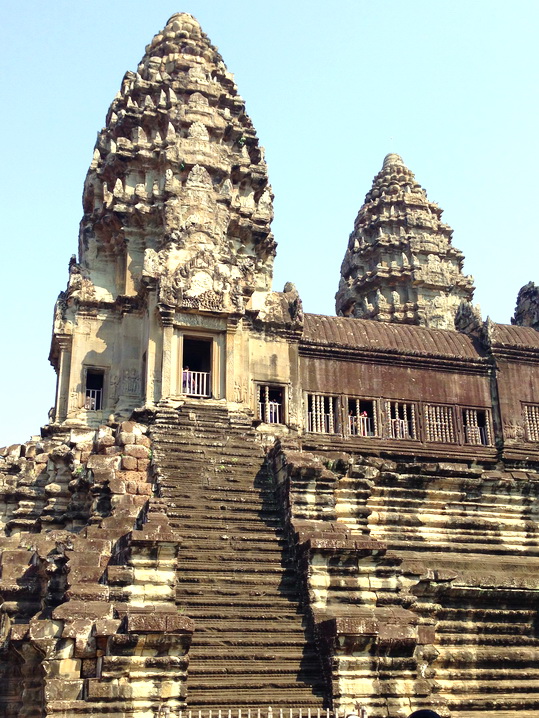
Angkor Wat was an enormous temple complex, spanning an impressive 200,000 square meters. The main temple structure stood tall at 60 meters, with a length of 100 meters and a width of 80 meters. Its architectural layout represented the pinnacle of Khmer temple development. The complex consisted of five towers situated on a raised platform, following the cosmological center of the universe. Surrounding the temple was a 1.5-kilometer-long outer wall, adorned with moats resembling the celestial ocean encircling Mount Meru. The construction required a staggering 600,000 cubic meters of stone, hauled from the quarries of Phnom Kulen, located over 50 kilometers away. More than 40,000 elephants and hundreds of thousands of laborers were employed to transport and carve the stone, with the project taking a collective century to complete. A team of 5,000 craftsmen dedicated their skills to intricate carvings, while the overall construction process lasted for up to 40 years.
The city of temples featured a tower that soared over 60 meters, serving as the centerpiece of the temple complex. It was akin to the center of the universe, attracting visitors from all walks of life. The ascent to the top was a steep climb, yet it held great significance as every traveler yearned to reach the pinnacle and witness the breathtaking view that awaited them there. It was undeniably the most magnificent panorama of the entire temple complex.
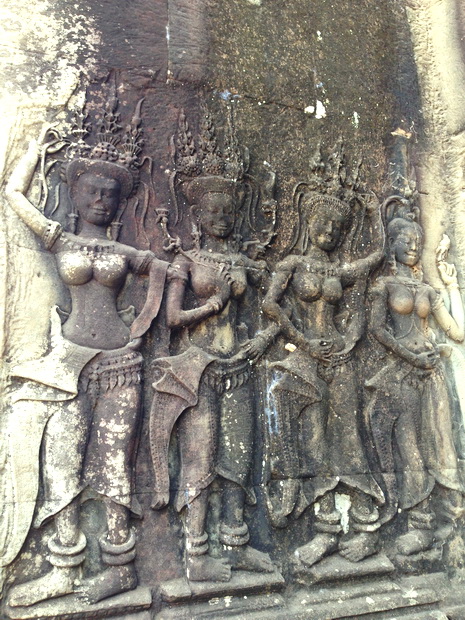
The outer wall surrounding the temple had a length exceeding 800 meters. It was adorned with intricate carvings depicting the royal duties of King Surayavaraman II and scenes from the epic Ramayana. Among the most renowned carvings were those depicting the celestial beings and demons engaged in a fierce battle with Lord Indra at the helm. Additionally, there were 1,636 carvings of heavenly nymphs (Apsara), each with unique attire and hairstyle, leaving no repetition among them.
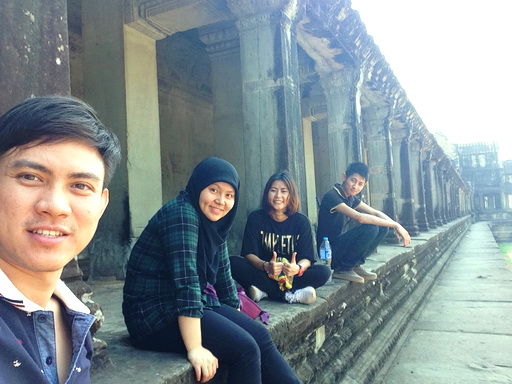
One of the most anticipated sights in the temple city, as my friend in this trip named “Bank” had told us, was the “Smiling Apsara.” Inside the temple complex, there were a staggering 1,636 carvings of celestial nymphs, each with a unique pose, making sure no two were alike. However, there was only one nymph with a “tooth-revealing smile,” which made her particularly special among the group of Apsara dancers. While we searched for the Smiling Apsara, we kept trying to ask the temple staff we encountered along the way. Luckily, most of them spoke Thai or English, so communication wasn’t an issue. As we strolled, whenever we came across something beautiful or peculiar, we would pause, admire, and take pictures at a leisurely pace, without feeling rushed. And if we grew tired, we would find a spot to rest because, after all, our group of four had covered quite a distance already. It’s only natural to have occasional breaks when you’re in your teenage years, right? Along the journey of walking, pausing, capturing photographs, and sitting down, we had spent nearly an hour following Bank’s advice to discover the intriguing wonders. Finally, we found the Smiling Apsara, thanks to the guidance of a young temple attendant who appeared to be around 20 years old and could speak a little Thai. We owe our gratitude to the enthusiastic volunteer who led us to witness the Smiling Apsara. Bank’s did ask the right person this time. :-)

.

.
.

.
.

SMILING APSARA – WE FOUND YOU !
.
.
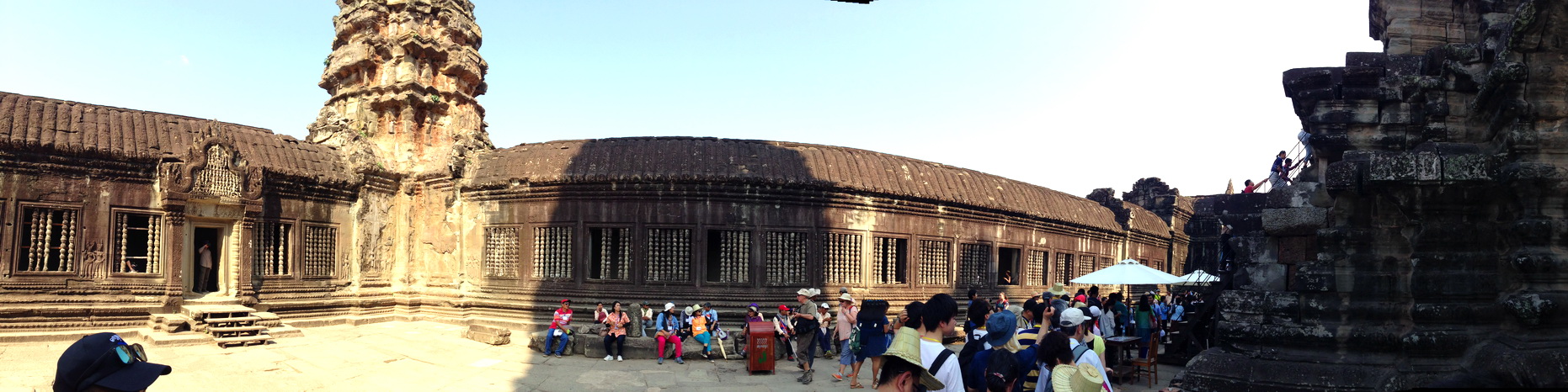
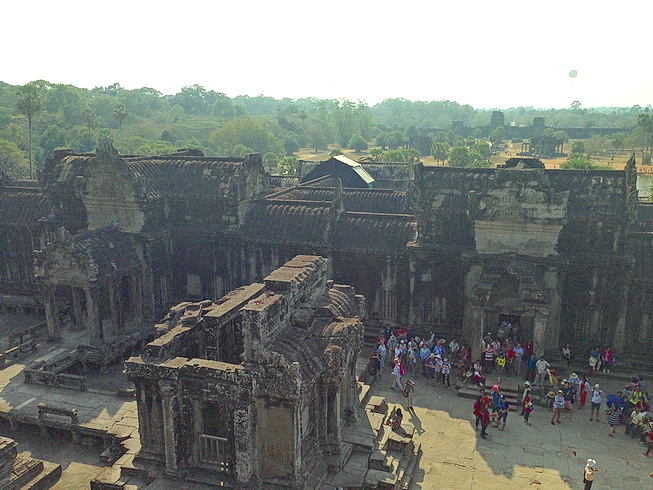
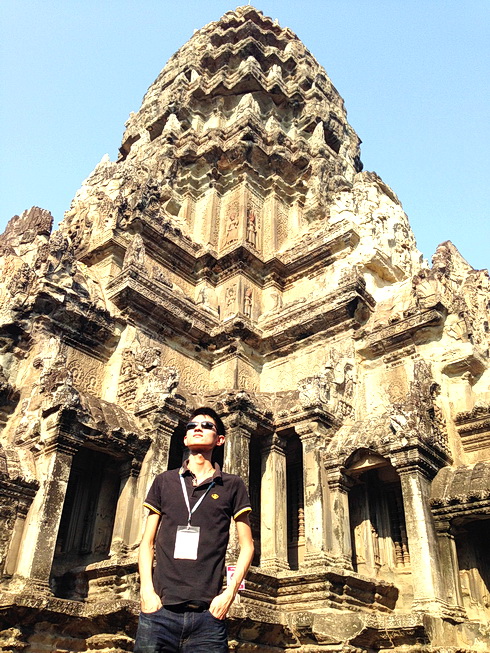
Another must-visit place within the temple city that no traveler should miss is the “Grand Hall.” This central structure of the temple is believed to be the center of the universe. As I mentioned before, every tourist eagerly wants to ascend and witness this majestic hall together, causing the queue for entry to stretch long. We patiently waited in line, clutching our numbered tickets, which were like golden passes to enter this awaited spectacle. Only those with these tickets could enter. It took us nearly an hour to reach the top, as the staircase was quite steep and required extra caution. But once we reached the top, I must say, the wait was truly worth it. Not only did we get to see the panoramic view of the temple city, but the upper level was adorned with intricate low-relief carvings and breathtaking architecture beyond description.
.

.
.

.

.

.
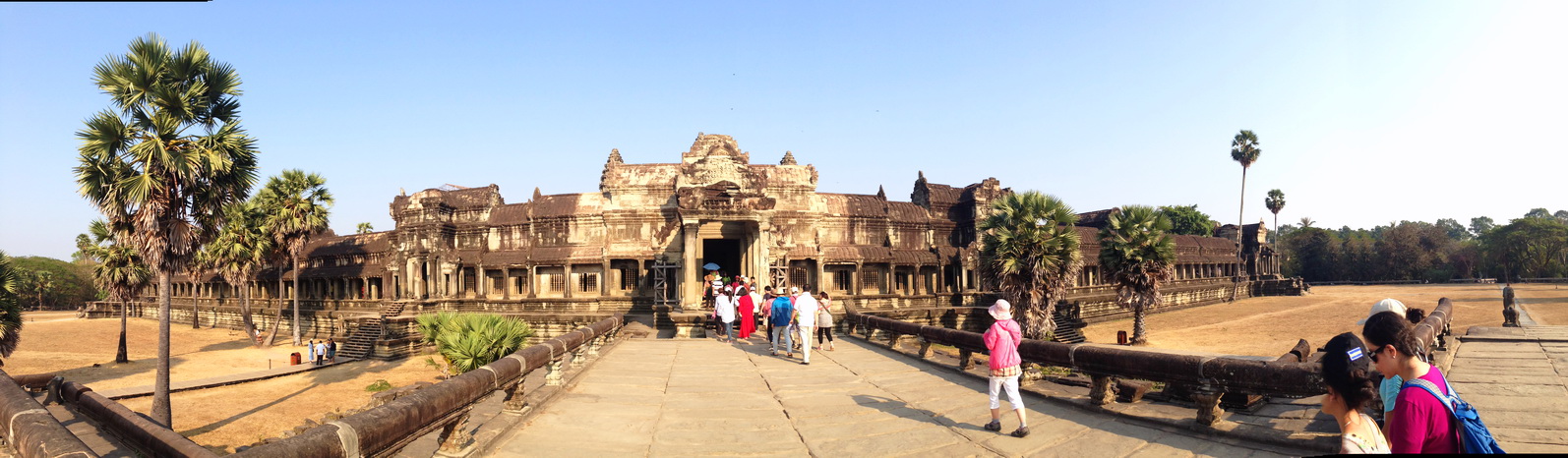
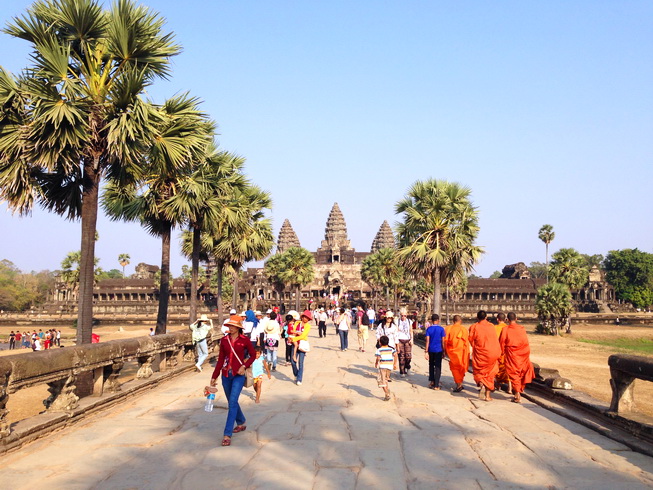
Once we had finished admiring the Grand Hall, the next stop was the front area near the water pond (where we had witnessed the sunrise in the morning). It was around 4PM at that time, and the atmosphere in that area had a different feel compared to the early morning darkness. However, it still retained its beauty just as before. It was not surprising that every traveler who had witnessed the sunrise in the morning would return to experience the evening ambiance once again. When we encountered the evening atmosphere of the front area of the temple, I must say it was simply “AMAZING.” It was both breathtakingly beautiful and magnificently grand, beyond any words that can truly describe it. It’s no wonder that this place is considered one of the wonders of the world.
.
.

.

.

.
After we had absorbed the enchanting atmosphere surrounding the temple, it was already five o’clock in the evening, the agreed time for our guide to pick us up and take us back to the hotel. It was perfect timing, as we concluded today’s trip with a sense of beauty and fulfillment, exactly as we had intended. We had made the most of our time since 5.30AM, witnessing the world’s ultimate marvels located just a few borders away from our country. But what made this trip truly memorable was the opportunity to experience the authentic flavors in every aspect. From getting conned by the mischievous local merchants to cycling through foreign lands with a thrilling sense of adventure. We had the chance to witness the way of life of the Cambodian people and indulge in genuine roadside local delicacies. This trip was incredibly exhausting, with scorching hot weather and endless walking. However, what we gained in return was truly priceless. Both the travel experiences and the moments spent exploring with friends, especially as we grow older, become increasingly rare. It’s difficult to arrange trips together with friends, for various reasons, as each person has different responsibilities and priorities that come with age. But on this trip, the four of us managed to come together and venture into the outside world. None of us had visited this foreign land before, allowing us to discover new things together and have an unexpectedly delightful time. The emotions we felt were more important than what we saw or physically experienced, making us believe that this was a complete trip. Because I’ve always believed that “a trip without anything perfect is, in fact, the perfect trip.” :-P
:::::::::::::::::::::::::::::::::::::::::::
Written By : SHIPY SIWARIT TIASUWATTISETH
 Shipy-Ship
ทริปนี้หมดไปเท่าไรคะ
LikeLike
ไม่เยอะครับ หมดคนละไม่น่าจะเกิน 5-6000 บาท ไปกัน 4 คน
LikeLike